Police Dog CPR Saves Life Inspiring Hero Dog Story

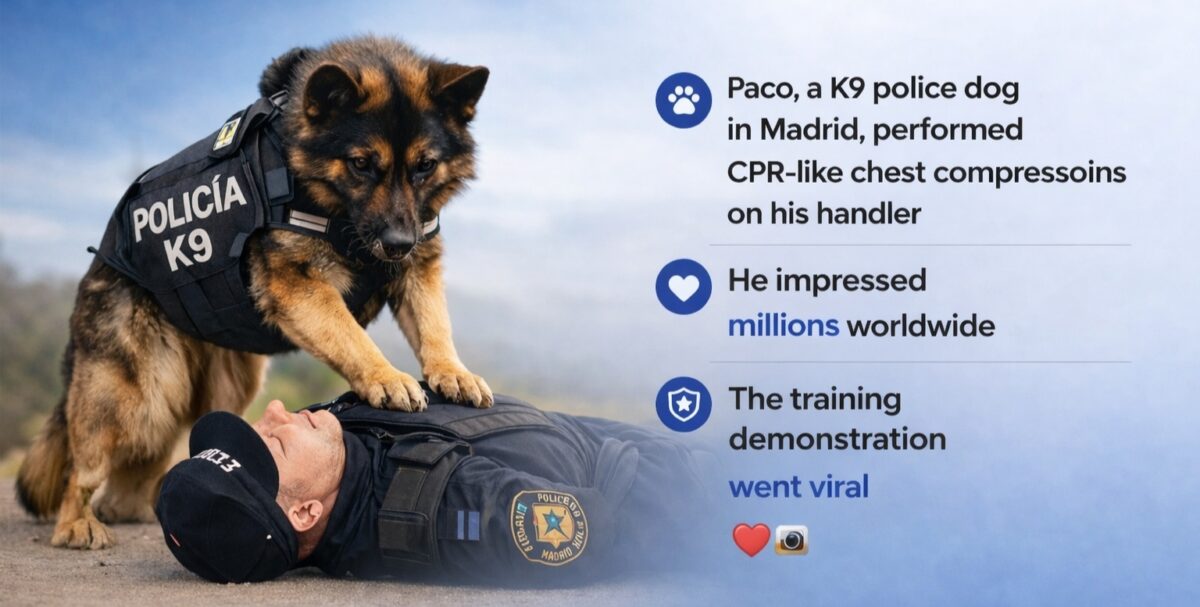
Some stories are unique because they have a deeper meaning, unlike others in the age of viral moments that spread in seconds. Among such stories is the Police Dog CPR story of Poncho, a Madrid police dog whose outstanding performance during a training exercise captured global attention. While a dog performing human-like actions may not seem unusual, what truly stood out was the accuracy, discipline, and life-saving potential behind his actions.
Police Dog CPR Training Exercise That Went Viral
In one of the regular police training exercises, Poncho was given a simulated situation of an emergency. One police officer was lying motionless on the floor, pretending to be suffering from a heart attack. Poncho, without wasting any time, would run towards the police officer and begin CPR.
Poncho delivered rhythmic chest compressions with his paws and followed his training with precision. Trainers adapted the technique to suit his anatomy, yet he matched the accuracy and speed required in real-life CPR situations. The sight amazed and inspired everyone, proving that properly trained service animals can achieve far more than expected.
More Than Just a Viral Moment.
While the video has gone viral on social media platforms, it has an effect far beyond the popularity that it garners online. The activities of the character of the person named by the reader as Poncho bring to focus the changes in the role of service dogs in contemporary society. These animals are not mere pets or helpers in detection; they are also being trained to perform complex life-saving treatments.
This scene is a reminder of the fact that behind all impressive performances is a background of strict training, patience, and confidence between the handler and the dog.
The Skill Behind the Training.
It is not that easy to teach a dog to do CPR. It requires:
- Higher levels of conditioning to react to particular stimuli and situations.
- Cases of repetition and reinforcement should be consistent when under pressure.
- Hander-dog communication to get it right.
- Training to desensitize the dog, therefore, making it not panic during an emergency.
Poncho’s performance reflects years of dedicated training, with trainers who understand both canine behavior and emergency response techniques.
Service Dogs and the Increasing Role.
The story of Poncho makes it possible to have a wider discussion on the power working dogs have. Service dogs have already been trained all over the world in several important positions, which include:
- Disaster zone search and rescue.
- Explosives and dangerous substances, including narcotics.
- Medical incidents and warnings, for instance, seizures and hypoglycemia.
- Support for people with disabilities.
The inclusion of emergency response measures such as CPR, even in a limited or supportive role, puts the limits of what these animals are capable of contributing to a test.
Why Police Dog CPR Matters in Emergencies
Every second matters in times of emergencies. Although such dogs as Poncho will not substitute human medical workers, they can serve as first-hand responders in cases when medical aid is not provided as quickly as possible. It can make a difference, even taking a step, notifying people, or making a basic intervention.
The intelligence and flexibility of dogs are also appreciated by the population as a result of the demonstration made by Poncho. It busters myths and promotes further investment in training programs that broaden their functions.
Police Dog CPR Story: A Symbol of Loyalty and Potential
Finally, Poncho is not just one great thing. He is a representation of the possible that is unleashed in training, trust, and instinct. His deeds make us remember that heroism may be in many different forms- and when it comes to Tom, it may be on four legs.
With the increase in technology and better training techniques, instances such as Poncho might become less of an exception. His performance clearly shows what humans and animals can achieve when they share a common mission: saving lives.