Taiwan Tests Robot Dogs for South China Sea Security

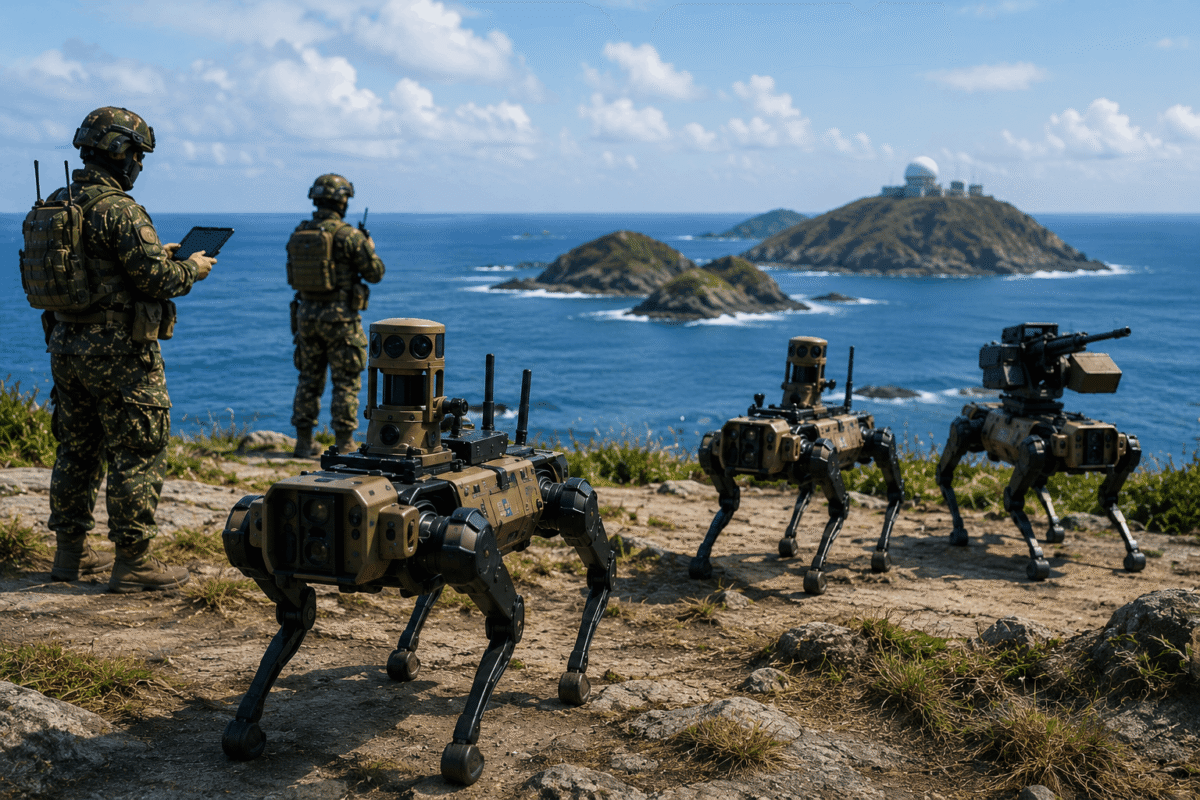
As military tech keeps moving forward, Taiwan is looking at new, somewhat clever ways to bolster security and watch over areas that matter a lot strategically. In a recent display, Taiwan showed robot dogs with really advanced capabilities that, someday, might patrol out in distant islands across the contested South China Sea, and this felt like a solid step toward tying robotics into modern defence work.
Taiwan’s Push Toward Advanced Defence Technology
Taiwan has been pretty actively trying to modernize its military strengths in response to what it sees as growing trouble in the region. In that whole picture, drones, autonomous systems, and artificial intelligence have kind of turned into core pieces of their defence game.
The most recent update is coming out of Taiwan’s National Chung-Shan Institute of Science and Technology, or NCSIST. They showed three different versions of robotic patrol dogs that were built by the U.S.-based Ghost Robotics, which is a well-known supplier of military-grade quadruped robots.
These robot dogs are meant to help servicemembers in the field, by doing things like surveillance, reconnaissance, and a bunch of security-related work when conditions are rough, or the environment isn’t friendly.
Three Specialized Robot Dog Variants
During the demonstration, Taiwan unveiled three different configurations of the robotic platform:
1. Reconnaissance Robot Dog
This version is designed to gather intelligence and then provide real-time situational awareness; in practice its always active.
2. Surveillance Robot Dog
With monitoring systems, this variant can patrol set zones, and it may detect unusual activities or behaviors that don’t quite fit.
3. Firepower Robot Dog
The most advanced version also features a mounted weapon system, showing how robotics can exist in combat-related operations, not just in theory.
Taiwan’s defence researchers have added their own technologies to the robot platforms, tailoring things to particular military requirements, so it feels more tuned than generic.
Why the South China Sea Matters
The South China Sea continues to hold immense strategic importance on the global stage. A bunch of countries claim pieces of it, mainly because of shipping lanes, natural wealth, and also the military value, you know.
Taiwan in particular manages:
- Itu Aba Island in the Spratly chain
- the whole Pratas Islands group
Those places work as key watch and security outposts even if there aren’t any permanent civilian residents there.
Defence officials believe the islands’ isolated locations provide a suitable environment for testing and operating robotic patrol units.
Potential Benefits of Robot Dog Deployment
Introducing autonomous patrol units could significantly enhance security operations in remote and challenging environments.
Enhanced Surveillance
- Continuous monitoring, capabilities
- Real-time intelligence, collection
- Reduced blind spots in remote areas, too
Improved Safety
- Keep risk as low as you can for the people on site
- Do patrol work in tricky, hazardous environments
- Stand by for security operations, especially in emergencies
Greater Operational Efficiency
- Fewer people needed, for sure
- Quicker return to any possible threats, maybe
- Longer roaming and surveillance range, basically
These features make robotic systems particularly useful for isolated islands where maintaining a large security presence can be challenging.
Responding to Regional Security Concerns
Taiwan says there’s been more action lately from Chinese coast guard ships and drone aircraft hovering around the Pratas Islands in recent years or so. Even though Taiwan and China both say they own big parts of the South China Sea, the situation stays tense, mostly because of competing claims and ongoing military presence in the area.
As for Taiwan’s side, its military has not yet issued an official order for these robot dogs, but defence officials admit there’s a rising need for fancier patrol tools for coastal and small island security tasks.
The Future of Military Robotics
The successful testing of robot dogs really does show a wider, global shift toward autonomous and semi-autonomous defence tech. As robotics, artificial intelligence and surveillance systems keep getting more sophisticated, military groups around the world are starting to look into how those systems can be used for safety, scouting, and protective operations, even when the situation is messy.
Taiwan’s robot dog program is also one more example of how these newer capabilities are rearranging modern military activity, and how armed forces are getting readied for upcoming problems.
References Link: https://www.ndtv.com/world-news/taiwan-tests-robot-dogs-that-could-soon-guard-south-china-sea-islands-11578930